Published: Tue - Apr 07, 2026
AI Agents and Customer Data: A Practical Compliance Guide for Indian Businesses in 2026


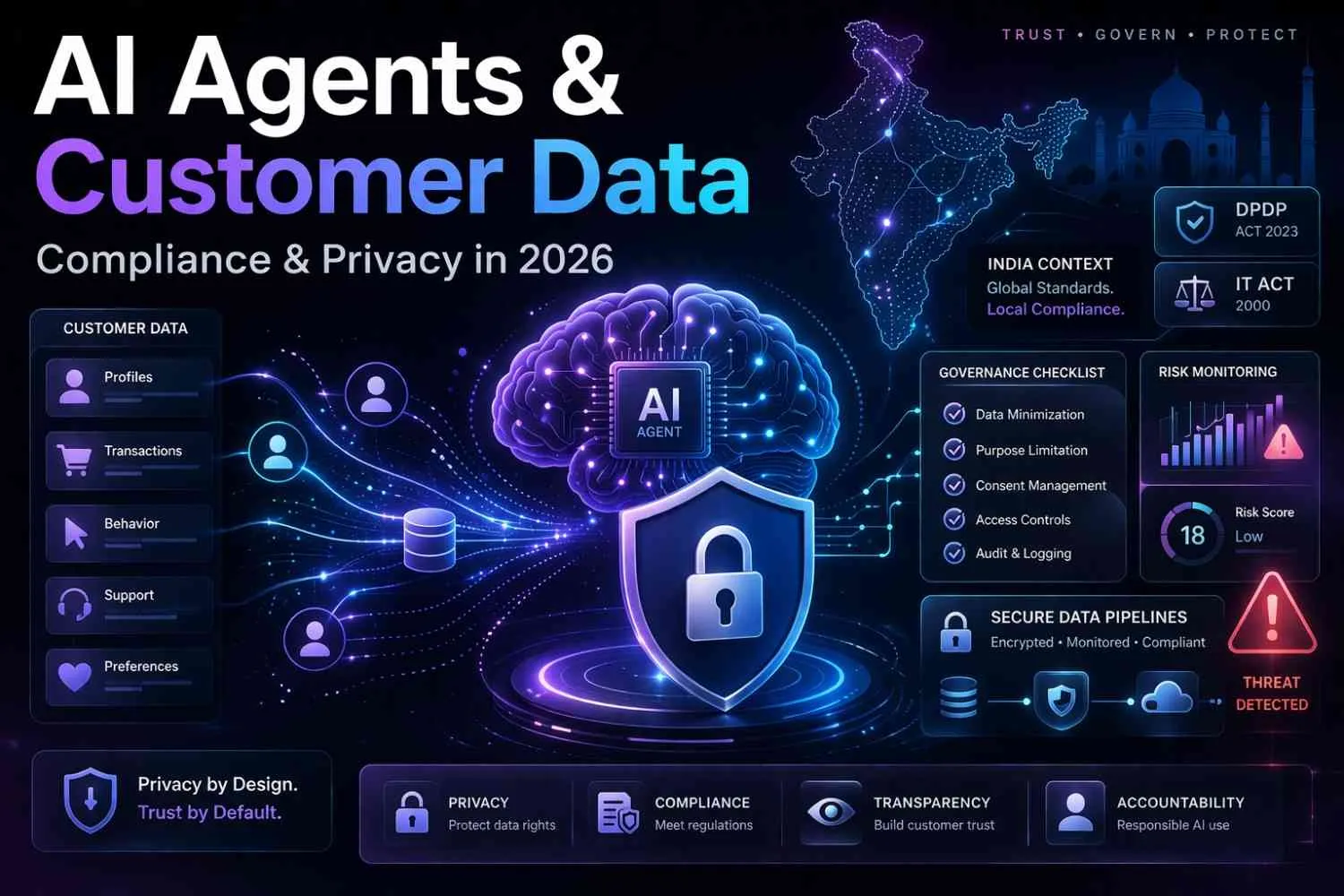
Picture this: you've just launched an AI chatbot to handle customer support. It's working well, response times are down, your team is free for higher-value work, and customers seem happy. Behind the scenes, the chatbot is logging every conversation, storing names and email addresses, linking queries to purchase history, and building behavioural profiles to personalise future responses.
Now the question: do you have legal permission to do all of that? Are you storing that data securely? Do your customers know it's happening? And if India's Data Protection Board comes calling, are you ready?
These are not hypothetical questions. As AI adoption accelerates across Indian startups and enterprises in fintech, SaaS, healthcare, real estate, and hospitality data compliance is becoming one of the most common gaps in AI deployments. This guide breaks down what the law actually requires, where businesses most often get it wrong, and what responsible AI data handling looks like in practice.
What Data AI Agents Actually Collect and Why It Matters
Modern AI agents don't just respond to queries. Depending on how they're built, they can collect and process significant volumes of personal data as a by-product of doing their job well.
A customer support chatbot typically logs:
- Full conversation transcripts, including complaints, questions, and personal circumstances the customer shared in context
- Contact details names, emails, phone numbers often without a separate data collection prompt
- Purchase and account history used to personalise responses
- Behavioural patterns what time customers contact you, how often, what issues they raise that feed future model training
A CRM automation agent processes even more: deal status, meeting notes, follow-up history, and often information about third parties mentioned in email threads. An AI document processor may handle sensitive financial or medical records.
The data problem isn't usually malicious intent. It's that the architecture decisions made at build time, what gets logged, where it's stored, how long it's retained, who can access it determine your compliance posture. And most founders don't think about those decisions until something goes wrong.
What India's DPDP Act 2023 Actually Requires
India's Digital Personal Data Protection (DPDP) Act 2023 is the country's most significant data protection legislation to date. It came into effect in 2023 and its rules are being phased in through 2026. For any business that collects or processes the personal data of Indian residents which includes almost every B2C or B2B SaaS company operating in India it creates clear obligations.
Here's what it actually requires, translated out of legal language:
1. Consent must be explicit, informed, and specific
You cannot bury consent in a terms and conditions page. The DPDP Act requires that users understand in plain language what data is being collected, why it's being collected, and how it will be used. For AI systems, this means your privacy notice needs to explicitly mention that an AI agent processes and may store conversation data, not just that 'we collect information to improve services.'
2. Data minimisation collect only what you need
The Act requires that you process only the personal data necessary for the stated purpose. If your AI chatbot can function without storing full conversation transcripts, it shouldn't store them. If your CRM agent doesn't need to log email content, it shouldn't. Over-collecting data isn't just a compliance risk, it's also a security one. Data you don't hold can't be breached.
3. Purpose limitation and retention limits
Data collected for customer support cannot be repurposed for marketing without fresh consent. Data that's no longer needed for its original purpose must be deleted. This creates a practical requirement: your AI systems need defined data retention policies baked into their architecture, not managed manually by someone who may or may not remember to run a deletion script.
4. User rights access, correction, and erasure
Indian residents have the right to know what data you hold about them, correct inaccurate data, and request deletion. For AI systems, this means you need to know where all personal data lives across your databases, your model's fine-tuning data, your logging systems, and any third-party APIs you've integrated with. If a customer asks you to delete their data, 'we can't because it's in the AI' is not a compliant answer.
5. Cross-border data transfer restrictions
If your AI system sends customer data to a model API hosted outside India OpenAI, Anthropic, Google, or others that's a cross-border data transfer. The DPDP Act permits this only to countries notified by the Indian government as having adequate data protection. This is still being finalised, but any business using overseas AI APIs for Indian customer data needs a clear legal basis for that transfer.
The Four Compliance Gaps We See Most Often
Based on the AI systems we scope and build at BeGig AI Studio, these are the compliance issues that come up most consistently especially in early-stage deployments:
- No data map. The team can't tell you what data the AI system collects, where it goes, or how long it's kept. This is the most common gap and the first thing any regulator would ask for.
- Consent designed for a form, not an AI. Privacy notices mention data collection but don't specify that an AI agent processes conversations or that data may be sent to a third-party model API. Technically non-compliant under the DPDP Act's specificity requirement.
- Logging everything by default. Many AI frameworks log all inputs and outputs by default for debugging purposes. Those logs often contain personal data. Without a retention policy and access controls, they become a liability sitting on a server somewhere.
- No deletion workflow. The system collects data, but there's no mechanism to respond to a deletion request. The data is spread across a database, a vector store, a fine-tuned model, and API call logs with no clear owner responsible for each.
How BeGig AI Studio Builds Compliance In From Day One
Security and compliance aren't features we add to a finished AI system. They're scope decisions made before a line of code is written.
At scoping, we define:
- Exactly what data the system touches, stores, and transmits and what it explicitly does not need to
- Data retention periods for each data type, with automated deletion or anonymisation built into the architecture
- Access controls who in your organisation can see what, and how that's audited
- The legal basis for any cross-border data transfer to model APIs
- A deletion workflow so you can respond to DPDP Act data requests without a crisis
We also produce a simple data map, a document that shows, in plain English, what data your AI system collects, where it lives, who can access it, and when it gets deleted. It takes half a day to produce at scoping, and it's the single most useful document you'll have if a regulator or enterprise client ever asks about your data practices.
If you're building or scaling an AI system and want to make sure compliance is part of the design, not a retrofit book a scoping call with BeGig AI Studio.
Frequently Asked Questions
Does India's DPDP Act apply to AI systems?
Yes. The Digital Personal Data Protection Act 2023 applies to any organisation that processes the personal data of Indian residents in digital form regardless of whether that processing is done by a human, a software system, or an AI agent. If your AI system collects, stores, or analyses personal data about Indian users, the DPDP Act's consent, purpose limitation, and data security requirements apply to it.
What counts as personal data under India's DPDP Act?
Under the DPDP Act, personal data is any data that can identify an individual directly or indirectly. This includes names, email addresses, phone numbers, device identifiers, IP addresses, and behavioural data linked to a person. For AI systems, this means conversation logs, user queries, purchase history, and any other data inputs that can be traced back to a specific individual.
Can I use an overseas AI model API (OpenAI, Anthropic, Google) for Indian customer data?
This is currently one of the most actively discussed compliance questions in India's AI sector. The DPDP Act allows cross-border data transfers to countries the Indian government designates as having adequate data protection. That list is still being finalised. In the interim, businesses should work with a legal adviser to establish a clear basis for overseas transfers and, at minimum, ensure the AI API provider has a Data Processing Agreement (DPA) that meets DPDP Act standards.
What happens if my business is not compliant with the DPDP Act?
The DPDP Act introduces a tiered penalty structure. Significant data breaches resulting from failure to implement reasonable security safeguards can attract penalties of up to Rs 250 crore (approximately $30 million). Failure to notify users of a data breach carries penalties of up to Rs 200 crore. Beyond financial penalties, non-compliance creates reputational risk with enterprise clients who now routinely include DPDP Act compliance requirements in vendor assessments.
What questions should I ask before commissioning an AI system to ensure data compliance?
Before any AI build begins, ask your delivery partner: What personal data will this system collect, and does it need all of it? Where will data be stored, and in which country? How long is data retained, and how is it deleted? What third-party APIs will receive personal data? How can we respond to a user's request to access or delete their data? What happens to data if we stop using the system? A partner who can answer all of these at the scoping stage not after delivery is one who understands compliance as an architecture problem, not a documentation problem.
Also read:
- Anthropic's Project Glasswing: What It Is, Why It Matters, and What It Means If You're Building with AI
- Ethical Automation: How Companies Ensure Responsible AI Use Without Slowing Innovation
Never miss a story
Stay updated about BeGig news as it happens