Published: Tue - Feb 10, 2026
AI Agents Explained: How Founders Build Smart Automation Systems in 2026


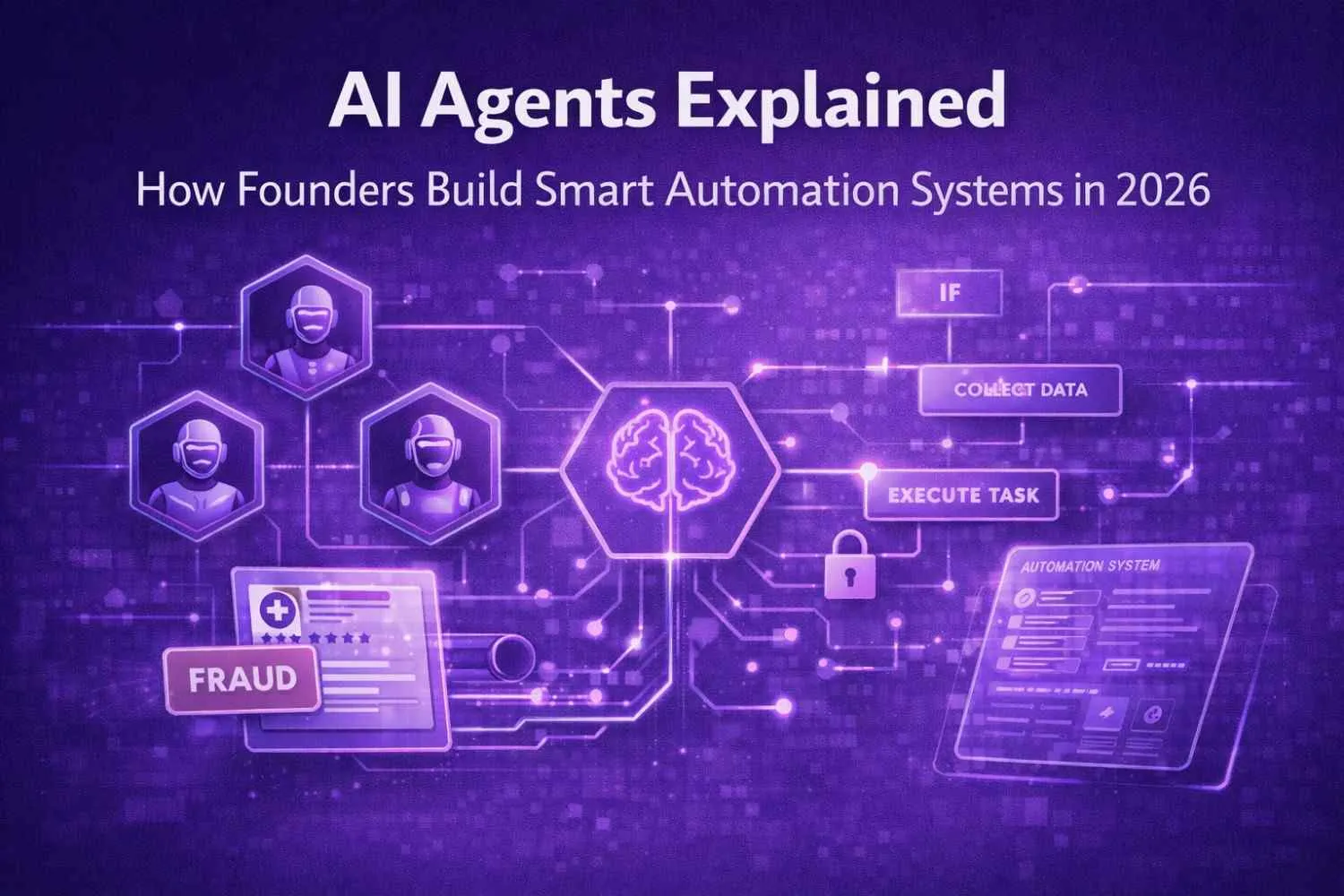
Artificial intelligence is no longer just about chatbots and content creation. In 2026, companies are already moving towards AI agents, intelligent systems capable of executing tasks, making decisions, and completing workflows on their own. From automating lead generation to handling internal business activities, AI agents are set to become the backbone of business automation.
Founders are always on the lookout for ways to scale their businesses without hiring more teams. Automation with AI agents is set to become a viable solution for founders. According to research on agent-based AI workflows, modern AI agents can automate structured tasks much faster than traditional manual methods while minimizing operational expenses. This makes AI agents among the most potent tools for startups and growing businesses looking to remain competitive.
In this guide, you will learn about what AI agents are, how to build AI agents with ease, and how founders can leverage AI agents to create scalable automation systems without having to deal with complex development teams. Let’s dive in!
Also Read: No-Code Automation Tools in 2026: Build AI Workflows Without Coding
What Are AI Agents and How Do They Work?
AI agents are intelligent software applications that can perform certain tasks independently. Unlike other automation software, AI agents have the capability to process inputs, make decisions, and take actions on multiple software applications or workflows. In simpler words, an AI agent is like a digital teammate:
It understands goals and context.
It takes actions based on instructions or data.
It optimizes performance through structured workflows.
Current AI agents are developed by integrating large language models with workflow orchestration platforms. Studies have found that agent-based systems are based on modular elements that work together as a team to automate complex tasks efficiently.
Examples of AI Agent Use Cases in Business
Lead-to-meeting automation
Customer support response systems
Proposal and RFP generation
Internal knowledge bots
Workflow automation across CRM and marketing tools
These systems enable founders to automate repetitive tasks while retaining control over strategy and decision-making.
Why AI Agents Are Changing Business Automation in 2026
The reason why the transition to AI-powered automation is taking place is that the traditional way of working cannot scale quickly enough to meet the needs of modern businesses. Founders are now using AI agents to automate their work instead of hiring multiple employees.
The reason why AI agents are becoming popular is that they offer the following advantages:
1. Faster Execution and Lower Costs
Comparative studies between human workflows and agent-based workflows indicate that automated agents are much faster in completing structured tasks. This makes them perfect for use in scalable automation systems.
2. Modular and Scalable Architecture
AI agents are designed using modular architecture, which means that businesses can scale their automation systems incrementally without having to rebuild the entire system from scratch.
3. Automation Without Technical Complexity
Founders believe that automation is a complex process that requires advanced coding knowledge. However, modern technology and no-code solutions make it possible for businesses to quickly implement agent-based workflows.
4. Decreased Need to Work with Large Teams
Founders no longer need to work with multiple freelancers or teams. They can now use automation workflows to automate repetitive tasks such as reporting, data analysis, or customer onboarding.
Want the technical side? Learn more in: AI Agents Frameworks Explained: The Technology Behind Modern Automation
How Founders Build AI Automation Systems Without Managing Developers
Creating AI agents can be a tough process, but founders today are using structured frameworks to make this easier. Here’s how founders can create AI agents:
Step 1: Find Repetitive Tasks
Identify tasks that take the most time, such as lead generation, reporting, content management, or internal business processes.
Step 2: Create the Automation Process
Divide the process into smaller steps:
Input → Processing → Output → Action
Example:
Lead is added to CRM → AI agent qualifies the lead → Meeting is automatically scheduled.
Step 3: Create or Use AI Agents
Founders don’t need to hire multiple developers to create AI agents. Many founders work with automation teams that create AI agents from scratch.
This is where platforms like BeGig Studio can help founders turn their ideas into execution using structured automation frameworks without worrying about the technicalities.
Confused between agentic AI and traditional automation? Explore: AI Agents vs Agentic AI: What Businesses Must Understand Before Automation
Build Smart Automation Systems Faster with BeGig Studio
AI agents are revolutionizing the way businesses work, but founders can find it challenging to create AI agents on their own. BeGig Studio makes this easier by providing:
- Discover → Develop → Deploy automation frameworks
- Business workflow AI agent development
- Custom automation without needing multiple teams
- End-to-end execution by a single expert team
Founders can focus on strategy and let automation systems work behind the scenes instead of dealing with developers. If you’re looking to scale your operations, minimize manual labor, and develop AI systems in 2026, automation is no longer a choice but a necessity.
Frequently Asked Questions (FAQ’s)
What is an AI agent in simple terms?
An AI agent is a software program that automatically carries out tasks using artificial intelligence, sometimes working with multiple tools or workflows.
Are AI agents different from chatbots?
Yes. Chatbots are primarily used for conversation responses, whereas AI agents perform tasks, make decisions, and automate workflows.
Do AI agents replace employees?
No. AI agents are usually used for repetitive tasks so that employees can concentrate on strategic tasks.
Can small businesses use AI agents?
Yes. Many automation solutions enable small businesses to implement AI workflows without requiring massive development teams.
Never miss a story
Stay updated about BeGig news as it happens