Published: Sun - Aug 30, 2026
Build vs. Outsource: When a Delivery Pod Beats Hiring a Single Freelancer


Build vs. Outsource: When a Delivery Pod Beats Hiring a Single Freelancer
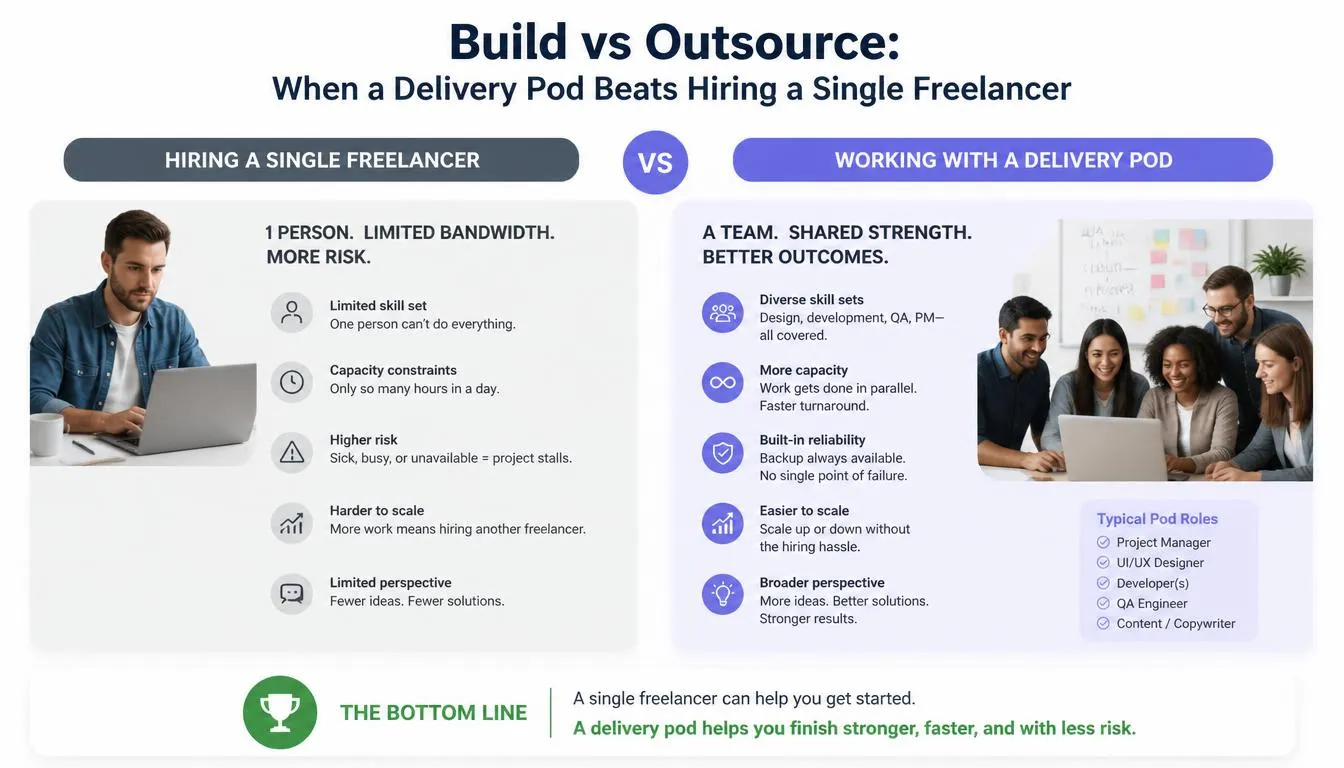
One freelancer is the right choice when it comes to narrowly defined, skill-specific tasks with one clear deliverable and low budgets. For continuous, skill-variety tasks requiring coordination and cohesion among members, a delivery pod - a small, cross-functional team led by one person - is the optimal solution. It is estimated, for example, that as of recent research done by Jobbers, 67% of companies use complete remote teams for their projects, compared to only 34% in 2022.
In many cases, the problem of choosing between freelancer, agency, and in-house team gets overcomplicated due to incorrect framing of the issue. In reality, most of the time it is not the general comparison that is needed but the much more specific one between one person and a pod of people who already know how to cooperate with each other.
What Is a Delivery Pod?
A delivery pod is a compact, cross-functional team assigned to a single body of work. Think a designer, a developer, someone handling content, a QA person, and a delivery lead coordinating all of it, working from one shared backlog under one standard and one service-level agreement. Everyone on the pod already knows how the others work, because they've usually done it before, together, on other projects.
Compare that to hiring a single freelancer. You get one person, one skill set, and one deliverable. It's a clean, simple arrangement, and for a lot of tasks, it's exactly the right amount of complexity. But a single freelancer isn't equipped to hand off a task to someone else if a project suddenly needs a skill they don't have, and there's no built-in mechanism for catching their mistakes before a client sees them.
Why More Companies Are Choosing Pods Over Solo Freelancers
The shift toward hiring teams instead of individuals isn't a hunch. Gartner's Future of Work research, cited by Jobbers, found that 67% of companies now hire entire remote teams for projects, nearly double the 34% that did so in 2022. Organizations are realizing, often the hard way, that a coordinated team tends to outperform a loose collection of individually hired freelancers, even when each freelancer is individually talented.
McKinsey's research on remote teams backs this up with harder numbers. Properly assembled teams deliver 34% higher productivity and 47% better project completion rates than ad-hoc groups of individual freelancers, according to the same McKinsey data cited by Jobbers. The gap is about the friction that disappears when people have already learned how to work together, instead of a founder or project manager stitching together strangers on every new task.
The Real Weakness of a Single Freelancer
Here's the part most hiring guides gloss over. A single freelancer is a single point of failure. If they get sick, take a two-week vacation, or simply move on to a bigger client, your project stalls, and you're back to sourcing and vetting someone new from scratch. In development circles, this gets called bus-factor risk, and it's a real, quantifiable liability, not just a hypothetical worst case.
There's also a quieter cost. A single freelancer, however talented, brings one perspective and one set of blind spots to the work. Nobody's reviewing their output before it reaches you. Nobody's catching the small mistake that a second set of eyes would have flagged in five minutes. That's not a knock on freelancers individually, it's simply a structural limitation of hiring exactly one person for a job that touches more than one discipline.
Where a Single Freelancer Still Wins
None of this means pods are always the right call. A single freelancer remains the better choice for narrow, well-scoped, single-skill work: a logo redesign, a landing page, a pitch deck, a one-off audit. Freelancers are, as one hiring guide put it, surgical: one person, one craft, one deliverable, and genuinely hard to beat on projects like that.
Budget matters here too. Freelancers tend to fit projects under roughly $30,000 where the work is straightforward and a single point of failure is an acceptable risk. Above that threshold, especially on projects with multiple moving parts or an ongoing timeline rather than a single deliverable, the calculus starts shifting toward a pod or an agency instead.
The Real Cost Comparison, Not Just the Invoice
The sticker price on a delivery pod will almost always look higher than the sticker price on a single freelancer. That comparison is misleading if you stop there. Teams typically cost 15% to 30% more upfront than an equivalent solo hire, but they also save 15 to 25 hours a week in management overhead, according to the same research. That's not a small number. It's roughly half of someone's work week freed up from chasing status updates, re-explaining context to a new hire, or manually checking whether different freelancers' work actually fits together.
Run the real math on your own time, not just the freelancer's invoice, and the gap between "cheaper" and "more expensive" often narrows a lot faster than it first appears.
How to Decide: A Simple Framework
A few questions tend to cut through most of the indecision here. How many distinct skills does this project actually need? One skill points toward a freelancer. Three or more points toward a pod. How long does this work need to run? A one-off deliverable favors a freelancer. An ongoing, ship-every-two-weeks kind of project favors a pod. How much oversight can you personally provide? If you don't have the bandwidth to manage handoffs between multiple independent freelancers yourself, a pod's built-in coordination does that job for you. And finally, what happens if your one hire disappears mid-project? If the answer is "the whole thing stalls," that's a strong signal you're carrying more single-point-of-failure risk than you should be.
If you're trying to figure out whether your next project needs one specialist or a small coordinated team, BeGig makes it possible to start with a single vetted freelancer and scale into a full delivery pod as the scope grows, without the overhead or markup of a traditional agency. You get the coordination benefits of a pod with the flexibility of hiring exactly the skills your project actually needs. Explore how BeGig builds delivery pods to see which model fits where your project actually stands right now.
FAQ
What is a delivery pod in freelance hiring?
A delivery pod is a small, cross-functional team of freelancers, often including roles like a designer, developer, content specialist, QA reviewer, and delivery lead, working together under one shared standard and timeline, rather than being hired and managed separately.
Is a delivery pod more expensive than a freelancer?
The upfront cost is usually higher, typically 15% to 30% more than hiring a single freelancer for comparable work. That premium is often offset by significant savings in management time, since a pod handles its own internal coordination rather than requiring you to manage multiple freelancers individually.
When should I hire a single freelancer instead of a team?
A single freelancer is usually the better choice for narrow, single-skill projects with a clear, one-time deliverable and a budget under roughly $30,000. Logo design, a landing page build, or a pitch deck are good examples of work suited to a solo hire.
How many people are typically in a delivery pod?
Pod size varies by project, but a common structure includes four to five people covering complementary roles, such as a designer, a developer, a content or QA specialist, and a delivery lead who coordinates the group and communicates with the client.
Never miss a story
Stay updated about BeGig news as it happens