Published: Tue - Oct 13, 2026
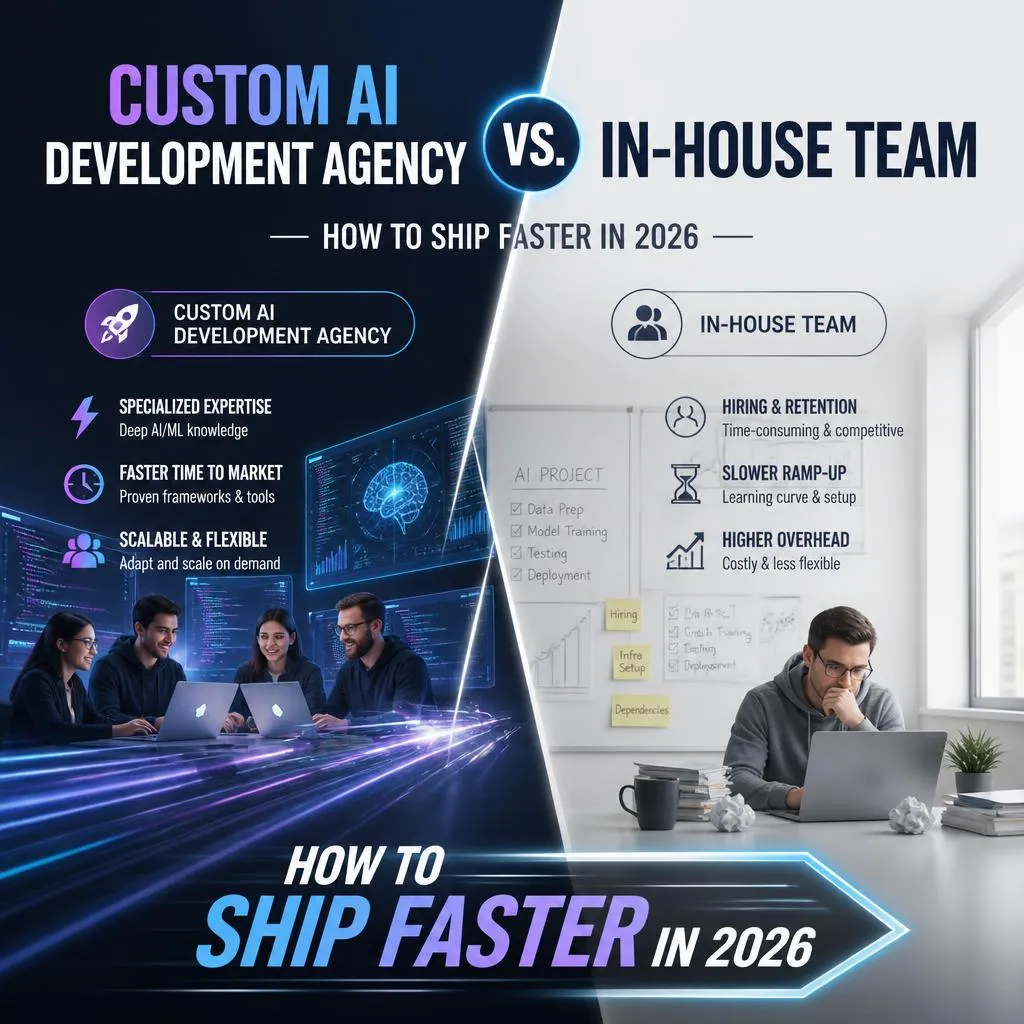
Custom AI Development Agency vs. In-House Team: How to Ship Faster in 2026


Disclosure: We run BeGig, a marketplace for pre-vetted tech talent and project execution, and Alternates.ai, a directory of AI agents. That means we have a stake in two of the options below. We have written the guide we would want to read as a buyer, including the cases where our own approach is not the right fit for your team.
The Short Version
- 1. First, check for existing tools: Determine whether a ready-made AI agent or off-the-shelf software already covers your needs. For standard operational tasks like helpdesk triage, automated meeting transcripts, or lead research, pre-built tools are often sufficient.
- 2. If you need custom execution fast: Partnering with a custom AI development agency or embedding pre-vetted AI specialists will generally get you to a live production model faster than starting a full-time hiring cycle from scratch.
- 3. Build in-house when AI is core to your IP: Invest in a permanent in-house AI engineering team if artificial intelligence forms your core product value, if strict regulatory requirements prevent data from leaving your infrastructure, or if you plan to build custom models continuously for years.
- 4. Consider a hybrid handover: Many technology leaders start with an outside execution partner to launch their first version quickly, then recruit internal talent over time while transitioning codebase ownership from day one.
Why This Decision Is Harder Than It Looks
Most advice on whether to hire a custom AI development agency or recruit an in-house engineering team comes from vendors selling one specific model.
The real challenge is matching the delivery model to your actual scope. A simple proof-of-concept that connects one data source to an LLM API is fundamentally different from an enterprise production agent that securely interfaces with your CRM, billing systems, and customer databases.
To choose the right path, you need to look at what each route actually requires in terms of time, long-term commitment, and technical risk.
The Three Main Delivery Paths
When bringing a custom AI solution or workflow automation to life, technology leaders typically evaluate three main paths:
1. Build In-House
You source, hire, and retain full-time artificial intelligence and machine learning engineers. You own the team, the code, and the infrastructure directly, while absorbing ongoing salary, benefit, and recruitment overhead regardless of workload fluctuations.
2. Buy a Pre-Built Agent or SaaS Tool
You subscribe to an existing software-as-a-service (SaaS) product or pre-built AI agent. This offers the fastest deployment and lowest initial cost, but you are limited strictly to the vendor’s feature roadmap and customization constraints.
3. Bring in Outside Talent & Execution Partners
- ~ Custom AI Development Agency (Project Execution): An end-to-end partner takes full responsibility for a defined project scope; from system architecture and prompt engineering to integration and final handover.
- ~ Embedded Specialists (Staff Augmentation): Pre-vetted AI, ML, and full-stack developers join your existing workflow directly to work alongside your team while you maintain project management.
Comparing the Options Across Key Dimensions
Build In-House
- ~ Resource Commitment: High permanent overhead (salaries, equity, benefits, recruiting, and infrastructure/compute tooling).
- ~ Speed to First Version: Slower initial ramp-up due to sourcing, technical screening, notice periods, and onboarding before development begins.
- What You Own: Full ownership of the code, internal technical knowledge, and a permanent dedicated team.
Buy a Pre-Built Agent
- ~ Resource Commitment: Predictable recurring software subscription fees.
- ~ Speed to First Version: Days to weeks for standard setup and configuration.
- What You Own: Access to a service; you do not own underlying code, model weights, or custom pipelines.
Hire an Agency (Project Execution)
- ~ Resource Commitment: Scoped project fee based on milestones and clear deliverables.
- ~ Speed to First Version: Rapid kickoff with dedicated scoping, typically moving from proof-of-concept to production deployment in structured phases.
- What You Own: Complete ownership of custom code, integrations, and IP upon project handover.
Embed Specialists (Dedicated Tech Talent)
- ~ Resource Commitment: Flexible hourly or monthly rates for specialized skill sets without long-term employment overhead.
- ~ Speed to First Version: Onboard pre-vetted engineers within days to start building immediately.
- What You Own: Complete ownership of code, repository commits, and direct team knowledge transfer.
Additional Costs to Account For
Regardless of which path you choose, remember that software costs extend beyond developer salaries or agency fees. Ensure your project plan accounts for:
- 1. LLM API & Hosting Costs: Model token usage (OpenAI, Anthropic, open-source hosting on AWS/GCP), vector database hosting, and server infrastructure.
- 2. Monitoring & Evaluation: Tools for hallucination detection, prompt evaluation, performance latency, and output logging.
- 3. Maintenance & Model Drift: Ongoing upkeep when model versions update, APIs change, or edge cases require fine-tuning.
- 4. Third-Party System Integrations: Connecting AI models safely into legacy enterprise systems, CRMs, and internal databases.
Speed: Where the Time Actually Goes
When shipping new technology, the largest bottleneck is usually not writing code, it is recruiting. Traditional hiring cycles for specialized engineering roles often involve lengthy sourcing processes, technical assessments, and multi-month notice periods before a candidate makes their first code commit.
An agency or dedicated talent marketplace does not necessarily make the underlying software development faster. What it removes is the upfront recruitment delay and learning curve.
Working with engineers who have built similar workflows before allows you to skip common architecture pitfalls, integrate APIs cleanly, and start building immediately.
Managing Risk
- 1. Knowledge Retention: With an agency, risk lies in an incomplete handover. With an in-house team, risk lies in single-developer dependencies if key staff leave. Mitigate both by enforcing strict documentation and paired engineering reviews.
- 2. Output Quality & Testing: AI applications can perform well in simple demos but fail when exposed to real-world edge cases. Establish clear test datasets and continuous evaluation pipelines early.
- 3. Vendor & Platform Lock-In: Avoid locking your infrastructure into a single model vendor or proprietary agency framework. Ensure all code, prompt templates, cloud infrastructure accounts, and evaluation sets remain hosted in your company’s accounts from day one.
- 4. Data Privacy & Security: Verify where your data is processed, ensure enterprise data is not used for public model training, and set strict permission boundaries for autonomous AI actions.
- 5. Intellectual Property (IP): Structure contract terms so that all written code, custom fine-tuned weights, prompt pipelines, and documentation belong 100% to your organization upon creation.
When Each Path Wins
Choose In-House Development When:
- → AI capabilities form the core intellectual property of the product you sell.
- → Highly sensitive or heavily regulated data cannot leave your internal cloud environment under any circumstances.
- → You plan to continuously design, train, and deploy custom AI features for years to come.
Choose Off-the-Shelf Tools When:
- → The workflow is standard across industries (e.g., meeting transcription, basic customer support routing, drafting initial email copy).
- → You need a functional solution in days without custom data integrations.
Choose a Custom AI Development Agency When:
- → You need a custom, complex AI application built within a specific timeline.
- → You have a defined project scope but lack internal engineering capacity or specialized AI expertise.
- → You want a complete, turnkey delivery without expanding permanent headcount.
Choose Embedded Specialists When:
- → You already have an internal product manager or technical leader to direct the project.
- → You need specific AI, machine learning, or full-stack expertise to accelerate an existing engineering roadmap for a few months.
A 6-Question Decision Framework
Before speaking with vendors or posting job requisitions, answer these six questions:
- 1. Is this AI capability central to your primary product offering?
- Yes: Leans toward building in-house.
- No: Leans toward outsourcing or buying.
- 2. Does an existing market tool satisfy roughly 80% of your requirement out of the box?
- Yes: Buy an off-the-shelf solution before spending on custom software.
- 3. Must all data remain strictly inside your isolated cloud infrastructure?
- Yes: Leans toward in-house or an embedded team working directly within your private cloud.
- 4. Do you need a functional, production-ready version deployed within 90 days?
- Yes: Leans toward an agency or pre-vetted specialists.
- 5. Will your team be building and iterating on complex AI models continuously for the next 2+ years?
- Yes: Plan to build internal engineering capacity over time.
- 6. Is there a dedicated internal stakeholder available to own product management and review outputs?
- Required: Every model; whether in-house, agency, or embedded requires an internal owner to succeed.
The Hybrid Path
Many growing companies adopt a hybrid approach: they engage an outside agency or embedded specialists to build and launch Version 1 quickly, then transition maintenance to internal hires as the product scales.
To execute a successful hybrid transition:
- 1. Maintain Native Account Control: Ensure all code repositories, cloud hosting environments, and model API accounts belong strictly to your company from day one.
- 2. Pair Internal Staff: Assign an internal engineer or technical product manager to shadow the build process and understand the system architecture.
- 3. Require Evaluation Sets as Deliverables: Make test datasets, prompt logs, and technical documentation required project deliverables and not optional add-ons.
- 4. Plan the Handover Point: Define clear criteria for when the system transitions from active agency development to internal maintenance.
How to Evaluate Any Execution Partner or Marketplace
When interviewing an agency, freelancer, or talent platform, ask these questions to gauge technical maturity:
- 1. Can you share production examples of AI workflows you have deployed, along with the operational metrics they improved?
- 2. Who are the specific engineers who will be writing code on our project?
- 3. How do you test output quality and guard against hallucinations in production environments?
- 4. How is our data secured, hosted, and protected against being used in external model training?
- 5. Do we retain full, direct ownership of the repositories, prompts, and pipeline code throughout development?
- 6. Can we start with a scoped proof-of-concept to validate the technical feasibility before committing to a full production build?
- 7. What is the continuity and handover plan if a key engineer assigned to our project changes?
Frequently Asked Questions
How long does outsourced AI development typically take?
A focused proof-of-concept generally takes 3 to 6 weeks. A complete production-ready build featuring custom data pipelines and enterprise integrations typically spans 8 to 20 weeks, depending on system complexity.
Is it safe to outsource AI development that involves sensitive data?
Yes, provided clear security protocols are established. You can structure engagements so that agency engineers work directly inside your enterprise cloud environment (e.g., AWS, Azure, GCP) using access controls, ensuring raw customer data never leaves your infrastructure.
Should I hire full-time AI developers or work with an execution partner?
Hire full-time developers if AI forms the core long-term foundation of your company's product. Partner with an agency or embed pre-vetted specialists if you need to ship a custom project within a defined timeframe without taking on permanent salary overhead.
What is the difference between workflow automation tools and custom AI agents?
Workflow automation tools (like Zapier or n8n) are ideal for linear, rule-based processes with predictable steps. Custom AI agents excel when a system needs to interpret unstructured data, make dynamic decisions across multiple software tools, or manage complex operational exceptions automatically.
Build Your Next Project With Begig
If you are evaluating how to build your next AI project or scale your engineering team, we can help you choose the right path.
- Looking for end-to-end execution? Explore BeGig Studio to outsource full-scope software and custom AI development with dedicated delivery.
- Need pre-vetted developers to augment your team? Use BeGig Talent to connect with top-tier freelance engineers, ML specialists, and full-stack talent ready to embed in your workflow within 48 hours.
Have questions about your project scope? Get in touch at hello@begig.io for an honest evaluation of whether you should build in-house, buy off-the-shelf, or partner for execution.
Never miss a story
Stay updated about BeGig news as it happens