Published: Tue - Aug 25, 2026
Full-Time vs. Fractional vs. Freelance: A Cost Breakdown for Business Leaders


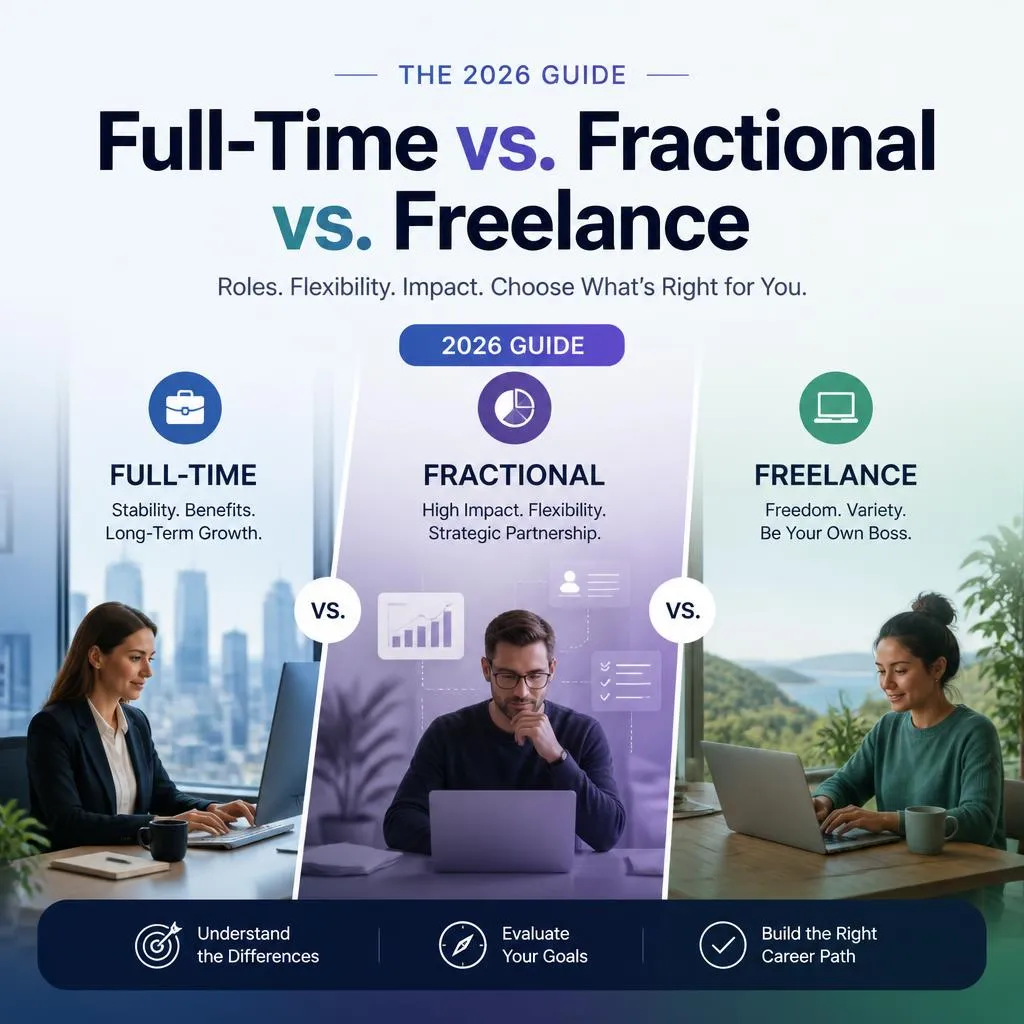
Most business leaders think they have two options when they need talent: hire someone full-time, or bring in a freelancer. That's the wrong frame. There's a third model, fractional hiring, that's grown fast enough in 2026 that skipping it in your planning could mean overpaying or under-resourcing a project you didn't have to.
Cost is part of the decision. But it's not the whole decision. Scope, accountability, and how long you actually need the expertise all change which model makes sense: the price tag follows from that, not the other way around.
What Each Hiring Model Actually Costs in 2026
A full-time hire is the most expensive option on paper, and it's usually more expensive than the salary number suggests. A full-time marketing manager, for example, typically runs $85,000 to $130,000 in base salary. Once you add benefits, payroll taxes, tools, and the 60 to 120 days it takes a new hire to reach full productivity, the real cost lands closer to $110,000 to $155,000 a year, before you've factored in what happens if the hire doesn't work out.
Freelancers cost less upfront, but you're paying for hands, not strategy. Rates vary widely, from $50 to $300 an hour depending on experience and specialty, with most businesses settling around $75 an hour or a $3,000 to $20,000 monthly retainer. That flexibility is real. So is the tradeoff: a freelancer executes what you tell them to, and when the contract ends, so does the expertise.
Fractional hiring sits in between, though the exact range depends heavily on seniority. Agency-style fractional teams often work within $500 to $5,000 a month depending on scope. At the executive level (a fractional CMO or CFO), the going rate is closer to $5,000 to $15,000 a month. Either way, you're paying less than a full-time salary and skipping the ramp-up time entirely.
It's Not Just About Price: Scope Changes What You're Buying
The cost comparison only tells half the story. What you're actually buying is different across all three models.
Freelancers are hired to execute. A freelance copywriter writes copy, a freelance developer ships code: the brief is yours, and the freelancer works inside it. Fractional executives are hired to lead. A fractional CMO doesn't just run your campaigns; they decide what the marketing strategy should be, what budget it needs, and whether it's working. The deliverable is the outcome of the function, not a piece of work.
That difference in scope shows up everywhere else, too:
→ Engagement length. Freelance work is typically project-based with a clear end date. Fractional engagements are ongoing, built around a function, not a task, because continuity is the point.
→ Decision-making. Freelancers take direction. Fractional leaders make the calls: on channels, positioning, what to cut and what to scale.
→ Accountability. A freelance writer is accountable for delivering ten blog posts on brief and on time. A fractional CMO is accountable for what the marketing function actually achieves: pipeline, conversion, cost per acquisition.
→ Vetting. Freelance platforms are open marketplaces where anyone can create a profile. Fractional networks tend to be curated: some accept fewer than 3% of applicants who apply, specifically because the cost of getting an executive hire wrong is too high to leave to a star rating.
None of this makes one model "better." It just means the two aren't interchangeable, and treating them as if they are is where a lot of hiring mistakes start.
The Market Is Shifting Toward Fractional: Here's the Data
This isn't a niche trend anymore. The global fractional executive market grew from $5.7 billion in 2024 to $9.4 billion by 2025. More than 40% of US small and mid-sized businesses are projected to be using fractional leadership by the end of 2026, and the buyer base has broadened well past SaaS startups into finance, manufacturing, and healthcare.
The shift has been building for a while. Fractional team usage rose 57% between 2020 and 2022, according to US Bureau of Labor Statistics data. Two forces are usually credited: remote work normalized the idea that expertise doesn't need to sit in your office, and companies realized they could access specialized skill for a specific initiative without building out an entire in-house department to support it.
Hiring Fractional or Freelance Talent in India: What's Different
If you're hiring in India, the model works the same way in principle, but the compliance layer is worth knowing before you sign a contract.
The most commonly fractional-hired roles in Indian companies are CFO, CTO, CMO, CHRO, and compliance or company secretary functions: the roles that carry high salaries and scarce expertise, where a full-time executive package doesn't make sense for an early-stage company yet.
Most fractional professionals in India are engaged as independent contractors rather than employees. That means professional fees are subject to 10% TDS under Section 194J of the Income Tax Act (renumbered Section 393 under the 2025 Act for payments made from April 2026 onward), and the professional needs to register for GST once their annual turnover crosses roughly ₹20 lakh (about $23,000).
The bigger risk isn't the tax paperwork: it's misclassification. If a fractional worker is treated like a de facto employee (controlled hours, day-to-day direction, embedded exactly like staff), a company can face backdated Provident Fund and ESI contributions, interest, and penalties. India's four Labour Codes, in force since November 21, 2025, now judge classification on the substance of the working relationship rather than what the contract says on paper. Keeping the engagement genuinely outcome-based and part-time is what keeps it defensible.
Four Questions to Decide Which Model Fits Your Project
Before you post a job or send a retainer proposal, run the decision through these four questions:
1. Do you need someone to execute a plan, or build one?
If the strategy already exists and you just need hands to run it, a freelancer works. If there's no plan, or the current one isn't working, you need someone thinking about the business, not just producing for it.
2. Is the need ongoing or project-based?
A single campaign or a busy season points toward a freelancer. A function that needs to run all year points toward fractional or full-time.
3. What happens if this person leaves in 60 days?
With a single freelancer or a single full-time hire, the honest answer is usually that you lose everything with them. A fractional model, especially a team-based one, doesn't carry that same single point of failure.
4. Are you solving a time problem, or a growth problem?
If the issue is "I'm out of hours in the day," a freelancer solves that. If the issue is "we're not growing," that's a strategy gap, and a freelancer alone rarely closes it.
If your answers keep pointing toward ongoing, senior-level ownership rather than one-off execution, fractional or specialized freelance talent is usually the fit, and that's exactly the kind of hiring problem BeGig is built to solve.
Full-Time vs. Fractional vs. Freelance, at a Glance
→ Full-Time. Typical cost: $110K–$155K a year, fully loaded. Scope: owns the function long-term. Commitment: ongoing, indefinite. Best for: core, long-term functions.
→ Fractional. Typical cost: $500–$15K a month, depending on seniority. Scope: owns strategy and outcomes, part-time. Commitment: ongoing, scheduled (for example, one to two days a week). Best for: senior expertise without full-time cost.
→ Freelance. Typical cost: $50–$300 an hour or $3K–$20K a month. Scope: executes a defined deliverable. Commitment: project-based, with a defined end date. Best for: discrete tasks and short-term needs.
The Bottom Line
Three options, three different cost structures, but underneath all of it is really one question: does your business need hands, leadership, or both, right now? Get that answer right, and the budget decision mostly makes itself.
Frequently Asked Questions
How much does a fractional executive cost?
Fractional executive rates typically range from $500 to $5,000 a month for agency-style engagements, up to $5,000–$15,000 a month for C-suite-level roles like a fractional CMO or CFO, well below the fully-loaded cost of a full-time hire.
What's the difference between a freelancer and a fractional executive?
A freelancer executes a defined deliverable under your direction. A fractional executive owns a function's strategy and outcomes, operating like a part-time member of your leadership team rather than an outside contractor.
Is fractional hiring compliant in India?
Yes, when structured correctly. Fractional professionals in India are typically engaged as independent contractors, subject to TDS under Section 194J and GST registration above the turnover threshold. The main risk is misclassification if the engagement functions like full-time employment in practice.
When should a business choose fractional over full-time?
When you need senior-level strategy and decision-making but aren't ready for a full-time executive salary, or when the need is real but doesn't require 40 hours a week, fractional hiring gives you that expertise without the fixed overhead.
Never miss a story
Stay updated about BeGig news as it happens