Published: Thu - Feb 26, 2026
OpenClaw vs AutoGPT vs Devin: Which AI Agent Framework Is Right for Your Business?


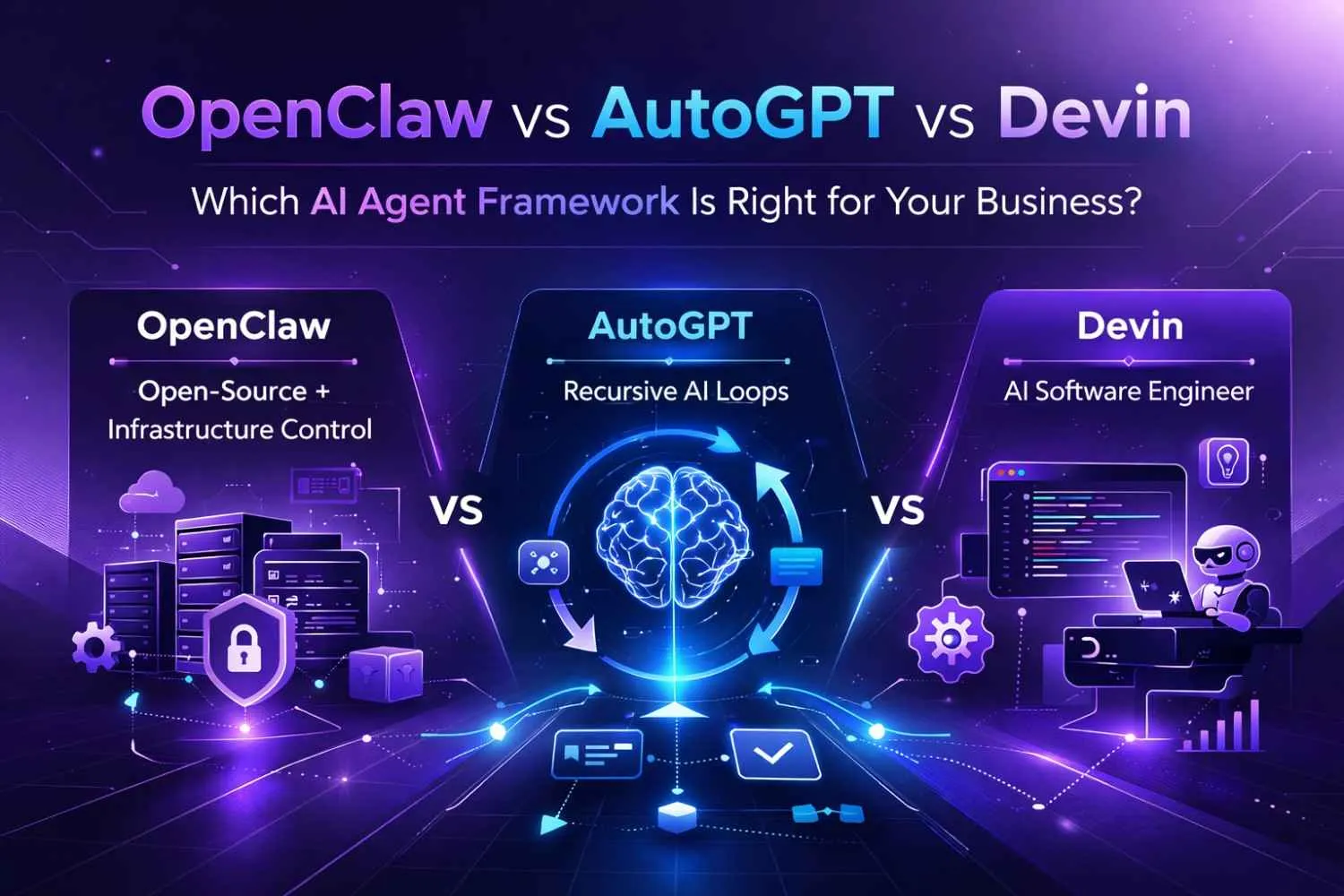
The transition from research tests to enterprise evaluation of autonomous AI agents is drastic. While AI chat interfaces have become widely popular due to big language models, the current trend is toward systems that can perform tasks, manage workflows, and act across software environments.
Organizations are no longer questioning whether AI can do research and produce unique content. They want to know if AI is capable of running systems. Devin, AutoGPT, and OpenClaw are the three names that come up most often in this discussion. Within the changing environment of AI agents, each one has a distinct architectural philosophy.
Today, this article helps you understand the difference between these autonomous AI agents while emphasising their architecture and specialisations. Let’s get started.
Also Read: Build vs Buy: Should Companies Use OpenClaw or Managed AI Agents?
The Rise of Autonomous Agent Frameworks
According to the updates from the AI industry, autonomous task systems are replacing static prompt-based tools. McKinsey’s research on generative AI states that organizations are increasingly experimenting with AI beyond content creation, extending it to multi-step workflows and operational processes.
This evolution can be summarised as:
LLM Chat Interfaces to AI Co-Pilots to Autonomous Execution Agents
Early systems assisted humans by providing a layer of support to help draft informative responses to their requests. Now, agent frameworks will,
Interpret your instructions,
Break your task down into manageable pieces,
Interact with relevant tools or APIs,
Execute the actions required of you, and
Iterate through this process without human intervention.
As we move through this evolution, the implications for governance and risk will be vast.
Architectural Differences
Despite being categorized as "AI agents," OpenClaw, AutoGPT, and Devin have quite different architectures and purposes.
OpenClaw: Local + Open-Source Execution
OpenClaw is an open-source autonomous agent that can operate on private infrastructure or a local host. It carries out tasks across applications and integrates with messaging platforms.
Features of architecture:
Deployment on a local or private level
Open source code
Permissions managed by the user
Cross-platform performance of tasks
The versatility of customization and infrastructure management is highlighted in this design.
In the past, open-source models have been quite transparent; yet, they need internal governance structures to control execution power.
AutoGPT: Iterative Autonomous Loops
One of the earliest experimental autonomous agents developed using GPT models was AutoGPT. It made the concept of recursive goal execution, in which an agent creates tasks, assesses outcomes, and then iterates, more well-known.
Essential characteristics:
Loops of goal-driven execution
An emphasis on experimental research
Model access that is dependent on APIs
Extensions driven by the community
Although AutoGPT has frequently needed manual supervision because of its unpredictable long-term loops, it earned attention for exhibiting autonomous reasoning chains.
Stanford HAI, 2023–2024 articles on agent dependability on autonomous agents brought to light in research discussions about hallucination control issues in multi-step reasoning systems.
Devin: Specialized AI Software Engineer Agent
Cognition Labs introduced Devin, a customized autonomous agent designed to do software engineering tasks. Devin is capable of:
Writing and troubleshooting code
In charge of repositories
Putting development processes into action
Iterating through cycles of problem-solving
Devin is vertically specialized in contrast to general-purpose agent frameworks.
Also Read: AI Agents Frameworks Explained: The Technology Behind Modern Automation
Make the Right Choice
OpenClaw, AutoGPT, and Devin do not have a clear winner. A distinct strategic philosophy is witnessed in each:
Infrastructure flexibility and control are given top priority by OpenClaw.
Autonomous reasoning experimentation is demonstrated by AutoGPT.
Devin concentrates on technical projects that require vertical expertise.
The targeted use case, technological competence, risk tolerance, and organizational maturity all have an impact on choosing the right option. Hence, before choosing a framework, businesses should internally assess their needs and requirements to understand what suits them better.
Frequently Asked Questions (FAQ’s):
1. What distinguishes AutoGPT from OpenClaw?
AutoGPT concentrates on recursive autonomous goal loops constructed on extensive language model APIs, whereas OpenClaw prioritizes local deployment and open-source task execution.
2. Is Devin a more sophisticated AI agent than others?
Devin specializes in workflows related to software engineering. Although it seems more suited for coding jobs, it is not necessarily more sophisticated in all areas.
3. Are frameworks for AI agents ready for the enterprise?
Many agents are still in the evolving stage and are not yet ready for enterprises.
4. What dangers are presented by self-governing AI agents?
Execution mistakes, security flaws, data leaks, and vendor dependence are among the risks.
5. How should companies assess frameworks for AI agents?
Use-case alignment, governance capability, security posture, infrastructure maturity, and long-term operating costs should all be evaluated.
Never miss a story
Stay updated about BeGig news as it happens