Published: Wed - Sep 02, 2026
7 Red Flags to Avoid When Hiring Freelance Tech Talent for Your Next Project


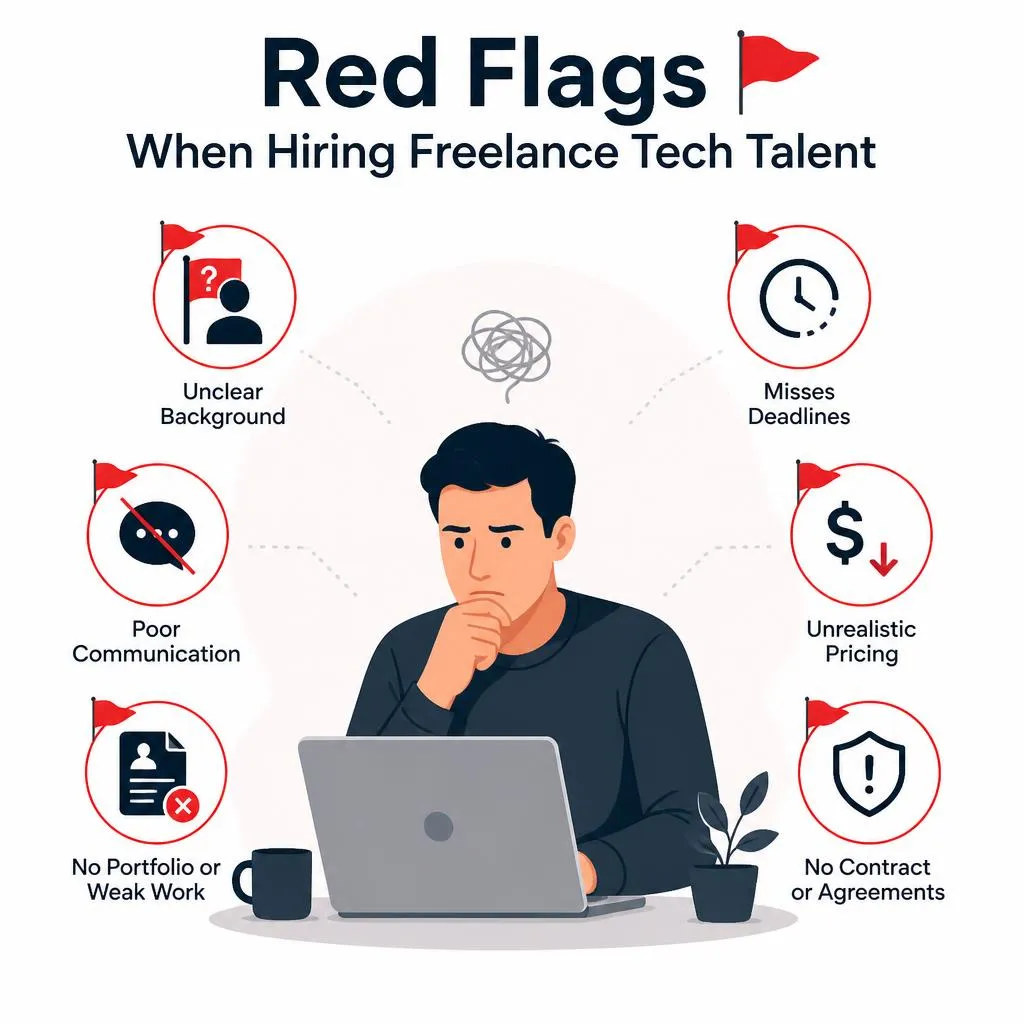
Hiring freelance tech talent can save weeks of recruitment time. It can also leave you with unfinished code, missing documentation, exposed credentials, and a deadline that keeps moving.
The difference usually appears before the contract is signed. A candidate’s proposal, portfolio, interview answers, and working habits reveal more than a polished profile ever will.
This guide explains the seven red flags to watch for when hiring freelance developers, remote developers, software engineers, cloud specialists, or other technical professionals.
Why careful screening matters
Businesses are hiring freelance technology professionals to fill short-term skill gaps, launch products, modernise systems, and handle specialist work in areas such as artificial intelligence, cloud computing, cybersecurity, and DevOps.
That demand is rising while technical talent remains difficult to find. The Linux Foundation’s 2025 State of Tech Talent Report found that organisations reported skills shortages in AI and machine learning, cybersecurity, FinOps, cloud computing, and platform engineering.linuxfoundation+1
The newer 2026 report still found significant capability gaps, including AI security and risk management, AI operations, cybersecurity and compliance, cloud computing, and platform engineering.linuxfoundation
When a project is urgent, hiring managers may overlook warning signs. That is where a structured freelance developer screening process becomes valuable.
1. The quote seems unrealistically cheap
A lower rate does not automatically mean poor quality. Freelancers in different regions have different operating costs, and an emerging developer may charge less while building a client base.
The concern is a price that sits far below every comparable proposal without a convincing explanation.
A very low quote may indicate:
💰 The freelancer has misunderstood the scope.
💰 The estimate does not include testing or documentation.
💰 The developer plans to renegotiate later.
💰 The person is inexperienced with similar projects.
💰 Several clients are competing for the same limited working hours.
💰 The proposal contains copied or generic information.
Upwork lists pricing that appears too good to be true among the warning signs clients should examine during the hiring process.upwork
How to investigate the estimate
Ask the freelancer to explain:
🔎 How the hours were calculated.
🔎 Which assumptions shaped the quote.
🔎 What is included in the deliverables.
🔎 What is outside the project scope.
🔎 Whether testing, deployment, and maintenance are included.
🔎 How changes to the requirements will be priced.
A professional developer will not know every detail before discovery. They should, however, be able to explain uncertainty.
A useful question is:
“Which part of this project is most likely to cause a delay or cost increase?”
A candidate who immediately identifies dependencies may be more reliable than one who promises an effortless launch.
2. The portfolio cannot be verified
A portfolio full of attractive screenshots is not enough for a technical hire. Screenshots show appearance. They do not prove ownership, code quality, scalability, testing, or deployment experience.
RapidBrains identifies inflated credentials and a lack of technical analysis beyond the resume as common warning signs when hiring remote developers.rapidbrains
Look more closely at the portfolio
🚩 There are no live links, public repositories, or product demonstrations.
🚩 Every case study uses vague language such as “helped improve performance.”
🚩 The candidate cannot explain their personal contribution.
🚩 The technology list is extensive, but no project shows how those tools were used.
🚩 The work appears copied from templates or another agency’s portfolio.
🚩 Claimed results have no context, timeframe, or measurement method.
🚩 The candidate refuses to discuss technical decisions despite claiming ownership.
Confidentiality may prevent a freelancer from sharing code or client data. That is reasonable. They can still describe architecture, testing, deployment, performance challenges, and their role in the project.
Ask the portfolio question that matters
“Which part of this product did you build yourself, and what was the hardest technical decision you made?”
Then ask what they would change if they were rebuilding it today. Genuine experience usually produces specific answers. Fabricated experience tends to remain at the level of buzzwords.
3. They suggest a solution before understanding the problem
A freelancer who immediately recommends a framework, programming language, or cloud provider may be solving the wrong problem.
Before proposing a technical solution, a capable developer should understand the product, users, existing systems, business constraints, and definition of success.
Questions worth hearing during the first call
💬 Who will use the product?
💬 What is the most important user workflow?
💬 What currently works, and what currently fails?
💬 Are there existing APIs, databases, or third-party integrations?
💬 What data needs protection?
💬 What traffic or performance levels are expected?
💬 What must be ready for the first release?
💬 Who will maintain the system after launch?
💬 Are accessibility, compliance, or regional requirements involved?
No questions at all is a red flag. It often means the freelancer is relying on assumptions or recycling a proposal written for another client.
Use a short discovery exercise
Give the candidate a brief project description and ask for:
🧠 Their understanding of the business problem.
🧠 Three risks they can already identify.
🧠 A suggested first milestone.
🧠 The information they need before starting.
This small exercise can reveal more than a long interview focused only on previous job titles.
4. They refuse a paid technical trial
A paid trial milestone gives both sides useful information before a large commitment.
It might involve a small API endpoint, a single mobile screen, a database design, a deployment plan, a bug fix, or a short technical audit. The task should resemble the proposed project without giving the client a complete production feature for free.
RapidBrains lists the absence of a trial or replacement policy as a risk in remote developer hiring.rapidbrains
A paid trial can reveal
🧪 How the freelancer interprets requirements.
🧪 Whether the work is tested properly.
🧪 How clearly the developer documents decisions.
🧪 How they respond when a requirement is unclear.
🧪 Whether they raise blockers early.
🧪 How they react to feedback.
🧪 Whether the work is maintainable rather than merely functional.
🧪 Whether deadlines and communication expectations are respected.
Do not turn a trial into unpaid labour. A complete website, full application module, or production-ready feature is not a reasonable test assignment.
What to include in the trial agreement
📄 A limited scope.
📄 A clear deadline.
📄 A fixed payment.
📄 Acceptance criteria.
📄 Ownership terms.
📄 A statement explaining whether the work will be used.
📄 The tools and access the freelancer will receive.
5. They treat security as an afterthought
A developer does not need to be a dedicated cybersecurity engineer to understand basic security hygiene. They should know how to protect credentials, restrict access, manage dependencies, and separate test data from production data.
The Linux Foundation’s 2026 research found that 57% of organisations reported capability gaps in AI security and risk management, while 40% reported being understaffed in cybersecurity and compliance.linuxfoundation+1
That shortage makes security screening important when hiring freelance tech talent, especially for projects involving payments, personal information, healthcare data, authentication, or internal systems.
Ask practical security questions
🔐 Where will API keys and database credentials be stored?
🔐 How will access be granted to the project repository?
🔐 Will production access be necessary?
🔐 How will user authentication be implemented?
🔐 How will open-source dependencies be reviewed?
🔐 What logging and monitoring will be configured?
🔐 How will test data be separated from real customer data?
🔐 What is the process for reporting a vulnerability?
🔐 How will access be removed after the contract ends?
Serious security warning signs
🚨 The freelancer requests shared passwords.
🚨 They want unrestricted production access from day one.
🚨 Secrets are placed directly in source code.
🚨 They recommend testing with real customer information.
🚨 They dismiss updates and dependency vulnerabilities.
🚨 They cannot explain how access will be revoked.
🚨 They say security is entirely the client’s responsibility.
Use individual accounts, multi-factor authentication, a password manager, least-privilege permissions, and a written offboarding process.
6. Their communication creates confusion
Remote work does not require constant availability. It does require predictable communication.
A freelancer may respond quickly yet still be difficult to work with if the replies are incomplete, contradictory, or disconnected from the project plan. Another may be quiet for days and then return with a large amount of unfinished work.
Upwork identifies disappearing during a project and poor communication management as hiring warning signs. RapidBrains also includes poor communication and lack of remote work experience among the risks associated with remote developer hiring.upwork+1
Watch the communication pattern
📩 Do they answer the question you asked?
📩 Do they confirm decisions in writing?
📩 Do they mention blockers before deadlines are missed?
📩 Do they provide useful progress updates?
📩 Can they work across time zones?
📩 Do they know when a meeting is necessary?
📩 Do they maintain a reliable response window?
📩 Can they explain technical issues without hiding behind jargon?
Agree on a working rhythm
Before the project begins, decide:
📅 The main communication channel.
📅 Expected response time.
📅 Meeting frequency.
📅 Progress-update format.
📅 Demo and review dates.
📅 Working-hour overlap.
📅 Escalation process for urgent issues.
📅 Person responsible for approving decisions.
A useful weekly update might look like this:
Completed: login flow and database migration
Next: staging deployment and error handling
Blocked by: payment sandbox credentials
Decision needed: confirm whether guest checkout is required
A clear update like this is more valuable than a long message filled with technical terminology.
7. They avoid responsibility for previous failures
Projects go wrong. Requirements change, integrations fail, and deadlines sometimes move.
The red flag is not a failed project. The red flag is a freelancer who cannot explain what happened, what they contributed to the problem, or what they changed afterwards.
Upwork warns that consistently blaming past clients or employers may indicate poor professionalism and weak accountability.upwork
Listen for blame-heavy answers
🚩 “The client was impossible.”
🚩 “The whole team was incompetent.”
🚩 “Nothing was my fault.”
🚩 “I only followed instructions.”
🚩 “The project failed because nobody listened to me.”
🚩 “Every project I worked on was delivered perfectly.”
A stronger answer includes context and ownership:
“The release was delayed because a payment provider changed its API. We had not tested that dependency early enough. I now add an integration spike before finalising the launch estimate.”
That answer does not claim perfection. It shows judgement.
Ask this interview question
“Tell me about a project that did not go as planned. What was your responsibility, and what did you change afterwards?”
The answer can help you assess maturity, honesty, communication, and problem-solving ability at the same time.
A safer process for hiring freelance developers
1. Create a specific project brief
📝 Business objective.
📝 Target users.
📝 Required deliverables.
📝 Existing technology stack.
📝 Project timeline.
📝 Budget range.
📝 Communication expectations.
📝 Security and compliance requirements.
📝 Definition of completion.
2. Review relevant evidence
✅ Similar project experience.
✅ Verifiable references.
✅ Clear explanations of technical decisions.
✅ Consistent reviews across several projects.
✅ Availability that matches your timeline.
✅ Familiarity with your collaboration tools.
3. Interview consistently
🎙️ Ask every shortlisted candidate the same core questions. This makes comparison easier and prevents a confident presentation from overshadowing weak evidence.
4. Start with a paid milestone
🧪 Limit the first assignment to a measurable piece of work. Review the result before expanding access or scope.
5. Use milestone-based payments
📌 Deliverable.
📌 Acceptance criteria.
📌 Due date.
📌 Payment amount.
📌 Documentation requirement.
📌 Review period.
📌 Intellectual property terms.
📌 Change-request process.
6. Control access from the beginning
🛡️ Use individual user accounts.
🛡️ Enable multi-factor authentication.
🛡️ Grant only the access needed for the current task.
🛡️ Keep repositories and cloud accounts under company ownership.
🛡️ Record who has access to what.
🛡️ Remove permissions when the contract ends.
🛡️ Require a documented handover.
Freelance tech hiring checklist
Before signing the contract, ask yourself:
☑ Can the freelancer prove relevant project experience?
☑ Can they describe their exact contribution?
☑ Did they ask thoughtful questions about the brief?
☑ Is the estimate based on clear assumptions?
☑ Does the proposed price match the scope?
☑ Can they explain their testing process?
☑ Do they understand basic security controls?
☑ Have they handled remote collaboration before?
☑ Is their availability suitable for the project?
☑ Will they complete a paid trial milestone?
☑ Are payment, ownership, and acceptance terms documented?
☑ Do you have a handover or replacement plan?
If several answers are negative, pause before hiring. A freelancer’s availability may be immediate, but project risk compounds quickly once development begins.
Final takeaway
The strongest freelance tech hire is not always the person with the lowest quote, the longest list of tools, or the most polished proposal.
Look for evidence, curiosity, realistic estimates, security awareness, dependable communication, and accountability. Those qualities are less dramatic than a flashy portfolio, but they are far more useful when the project meets its first real obstacle.
A careful screening process does not eliminate every risk. It makes the important risks visible while you still have time to respond.
Frequently asked questions
What is the biggest red flag when hiring a freelance developer?
A pattern of warning signs is more concerning than one isolated issue. Unverifiable work, unrealistic promises, vague estimates, weak communication, and resistance to a paid trial together should prompt further investigation.
Should I always select the cheapest freelancer?
No. Compare relevant experience, technical quality, communication, reliability, testing, documentation, and post-launch support. The cheapest quote can become expensive when it produces rework or delays.
Is a paid coding test fair?
Yes, if the assignment is short, relevant, clearly defined, and paid. Do not ask candidates to build a complete production feature without compensation.
How can I verify a freelancer’s portfolio?
Ask what the candidate personally built, request live demonstrations where confidentiality allows, review public code when available, contact references, and ask detailed questions about architecture, testing, deployment, and trade-offs.
How can I hire remote developers safely?
Use a written contract, milestone-based payments, individual accounts, multi-factor authentication, least-privilege access, secure credential storage, documented ownership, and a clear offboarding process. Include security awareness in the technical screening.
Never miss a story
Stay updated about BeGig news as it happens