Published: Thu - Feb 12, 2026
Workflow Automation Examples That Replace Manual Work in 2026


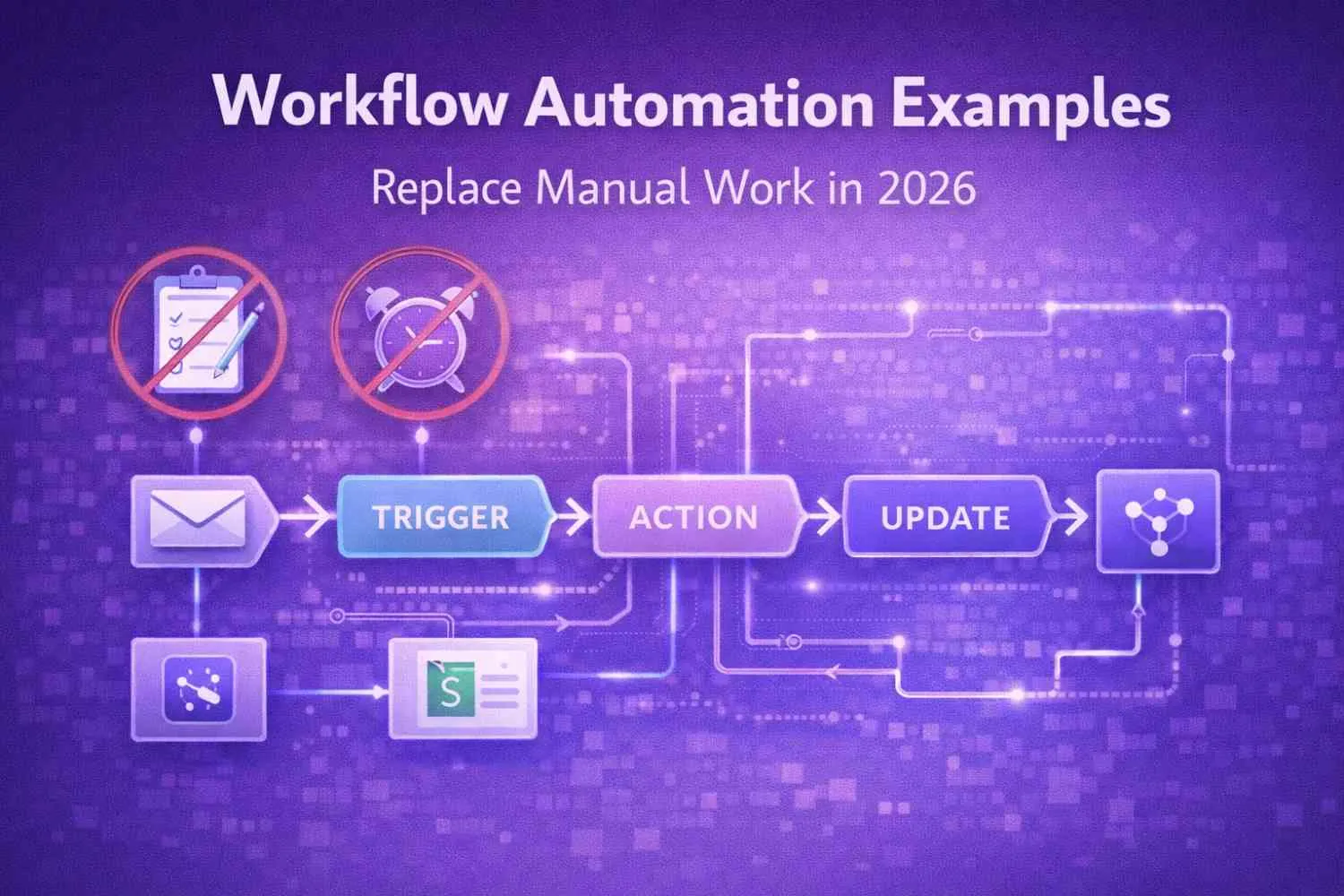
In 2026, instead of expanding by hiring more people, companies are expanding by automating more intelligent workflows. Automation is revolutionizing the way companies handle sales, operations, recruitment, and reporting. Founders no longer spend time on repetitive tasks; instead, they use workflow automation software powered by AI and no-code technology to automate tasks faster and cheaper.
Research studies on AI-powered automation and digital transformation indicate that automation has a profound effect on improving operational capabilities by eliminating bottlenecks and enabling teams to concentrate on higher-value tasks.
Automation workflows are becoming the new spine of business systems for startups and corporations. In this guide, we will examine actual workflow automation examples, how they automate manual processes, and how founders can automate workflows faster using BeGig Studio.
Also Read: From Manual Workflows to Automated Business Systems: The BeGig Studio Approach
What Is Workflow Automation and Why Does It Matter
Workflow automation is the process of using software or AI to automatically perform tasks based on triggers and logic. Rather than manually sending emails, updating spreadsheets, or following up on leads, automated workflows can complete the entire process with ease.
The latest automation tools use the trigger → action → outcome model. Research on low-code automation platforms indicates that workflows are created by combining actions that automatically trigger once the workflow is set in motion.
Why automation is becoming a necessity in 2026
Companies want faster execution without raising labor costs
Remote work demands organized digital workflows
Knowledge-based tasks can be automated using AI tools
Founders should have more time for strategy, not operations
Research by Cornell University on AI productivity indicates that automation can greatly lower manual transaction workloads and save thousands of hours of labor every year. In conclusion, workflow automation is no longer a luxury but a necessity!
Founders looking to scale faster should check: How to Automate Your Business Using AI (Without Hiring Large Teams)
Workflow Automation Examples That Replace Manual Work
Let’s examine real-world automation processes that are currently in use by businesses in 2026.
1. Lead Generation and Sales Automation
Instead of manually qualifying leads, businesses can now:
A form submission triggers CRM entry
AI scores the lead
Automated email outreach begins
Sales meetings get scheduled automatically
This automates several manual jobs, such as lead researcher, outreach assistant, and CRM manager.
2. Document-to-Delivery Automation
Instead of manually processing client inputs into deliverables, businesses can now:
Extract data from uploaded documents
Generate summaries or reports
Send outputs directly to clients
This automates manual editing and communication between teams.
3. Knowledge-to-Decision Automation
Instead of manually interpreting dashboards and reports, businesses can now:
Pull data from multiple sources
Generate insights automatically
Notify teams when action is needed
This automates data interpretation into decisions in real-time.
4. Hiring Workflow Automation
Instead of manually processing applicants, businesses can now:
Applications trigger AI screening
Candidates are scored automatically
Interview schedules get generated
This automates manual hiring processes and saves time for recruitment teams.
5. Customer Support Automation
Instead of manually processing customer queries, businesses can now:
Categorize incoming queries
Draft responses
Escalate complex cases automatically
This automates manual customer support processes and saves time.
Tool recommendations are covered in: Best Business Automation Tools in 2026: What Founders Should Actually Use
How BeGig Studio Builds Automation Workflows Faster
BeGig Studio concentrates on end-to-end automation of workflows using its Discover → Develop → Deploy approach, whereas other firms try to automate by integrating various tools.
Discover
The team will examine your workflows to determine which bottlenecks can be automated.
Develop
Automation pods create AI workflows, ranging from lead systems to internal dashboards, without requiring founders to handle freelancers or multiple vendors.
Deploy
Your automation solution is tested, integrated, and deployed as a fully functional system.
Rather than dealing with multiple tools, firms receive an integrated automation plan optimized for scalability. Begin with a free audit today and learn how you can automate workflows with ease!
Frequently Asked Questions (FAQ’s)
1. What is workflow automation?
Workflow automation is the process of automating repetitive tasks using software or AI technology based on triggers and rules.
2. Are automation workflows only for large companies?
No. Startups and small businesses will benefit the most from automation because it cuts down on hiring costs and accelerates business.
3. Do I need coding knowledge to automate workflows?
No. Many automation tools today are developed using no-code or low-code platforms.
4. Can automation replace employees?
Automation replaces repetitive tasks so that employees can concentrate on creative and strategic thinking.
5. What industries benefit most from automation?
The marketing, SaaS, fintech, healthcare, e-commerce, and consulting industries are adopting automation at a rapid pace.
Never miss a story
Stay updated about BeGig news as it happens