Published: Mon - Mar 02, 2026
Automation in Education: How Schools and EdTech Platforms Are Reshaping Learning with Smart Workflows


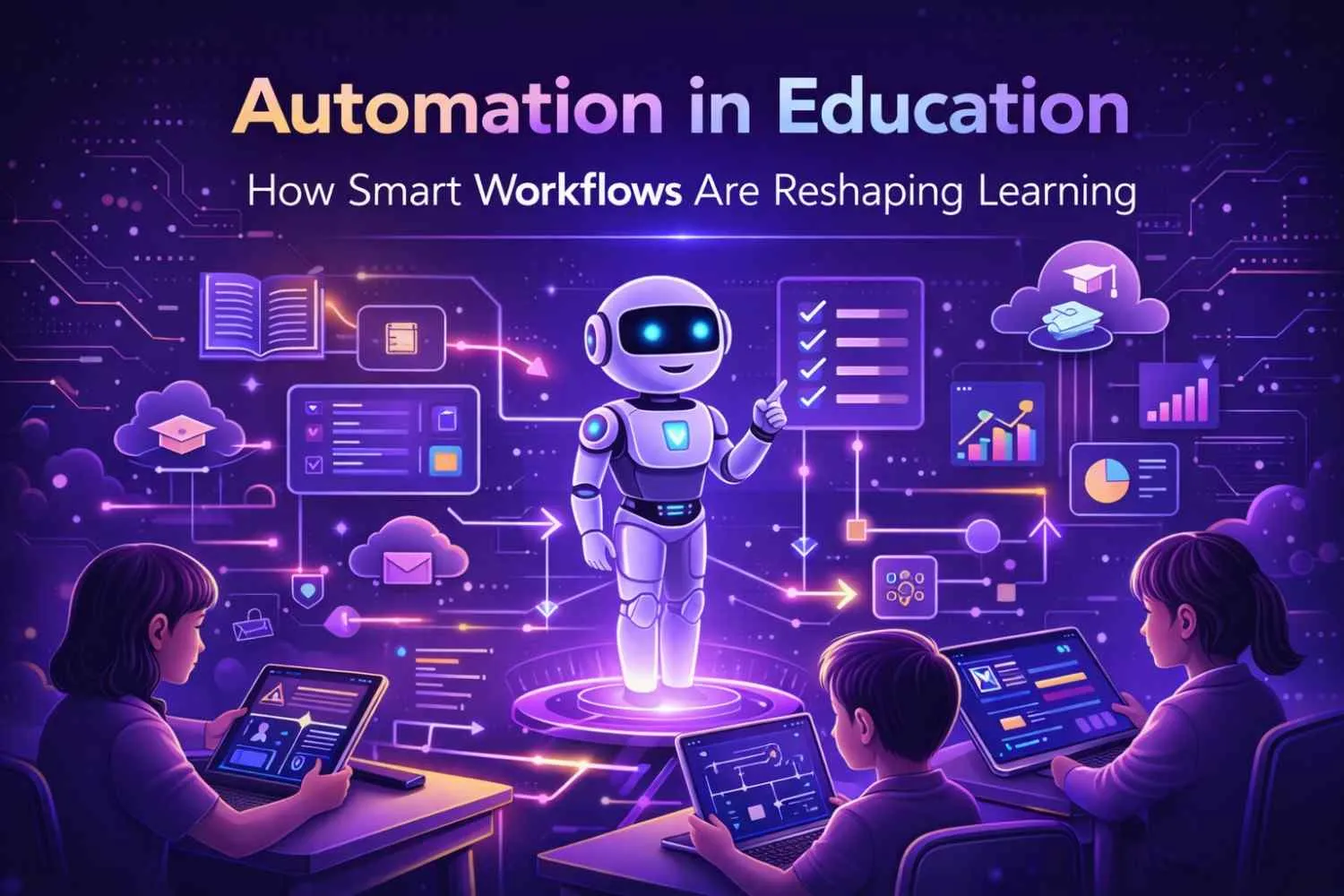
Schools and EdTech platforms are no longer just confined to a blackboard and a classroom. Digital education has been shaping the interactive learning environment, benefiting students. Now, with the enormous growth of AI and free-to-use scenarios, it can help both learners and educators in many ways.
In this era of AI, subjects can be taught in a fun and practical approach without the hassle of manual and financial constraints. A recent article from UNESCO states that “artificial intelligence has the potential to address the biggest challenges in today's education.”
From personalised learning to smart workflows, AI has endless possibilities to make education an interactive and amazing experience while eradicating repetitive manual tasks. Many educational societies and EdTech platforms have already integrated AI learning environments into their course schedules, encouraging global talent.
Now the important question is, “To what extent can AI be used in education?” Implementing AI tools not only has huge benefits but also a few risks if not approached carefully. So today, this guide helps you understand all these possibilities to help you take the right step in your educational journey. We will discuss why India is a unique case for automating educational processes, how schools can practically approach automation, and the limitations. Let’s get started!
Also Read: Sarvam AI vs OpenAI: Can India’s AI Stack Compete Globally?
Why India is a Unique Case for Education Automation
Huge population of learners, multiple teaching boards and languages, constraints for digital education, rural localities with few educational facilities, make India a unique case for education automation.
Language coverage and localized content: India has many languages, which means workflows should be trained for both Hindi and all the regional languages. Global tools that perform well in English often underperform in local dialects and explanations, making it difficult to integrate automation.
Cost and infrastructure sensitivity: Exceptionally trained global tools are priced in USD and require heavy cloud computing capabilities, which is a drawback for Indian schools and small EdTech startups. Domestically trained and hosted automation tools can seamlessly ease the integration.
Digital inclusion gap: India has diverse localities across sectors, with thousands of rural communities without access to digital infrastructure or the internet. This creates a gap in the digital learning environment and explains why tech dependence can widen inequality.
Multiple case studies show that rural India covers 65% of the total population, but accounts for less than half of the internet users in the country. The ASER survey from 2021 found that only 11% of the rural children had access to online education during the COVID-19 pandemic.
Practical Implementation: How Schools Should Approach Automation
Define clear learning goals: Automation should address an explicit problem (e.g., reducing grading time by X%, helping students master fractions sooner).
Pilot small and measure quickly: Run small pilot tasks with well-defined KPIs (engagement, mastery, time saved).
Prioritize teacher-facing UX: The tools should not create additional administrative burden for teachers. They should rather help them save time to engage with students.
Localised language and content: A local dataset should be built to understand the regional specificities and requirements.
With these careful decisions and implementations, automation can be a successful addition to schools all across India.
Also Read: OpenClaw vs AutoGPT vs Devin: Which AI Agent Framework Is Right for Your Business?
Automation is a Powerful tool, not a Replacement
Implementing automation in education can be a game-changing decision, but only when handled with care. Automating everything is not ideal for learning and teaching. Human interaction and explanation are vital for a good learning environment.
If you are an EdTech founder or a member of an educational institution from India, you need to start with clear goals, such as understanding local dialects and prioritizing teacher adoption. Automation will make an impact for sure, but it can never replace the human mentorship and judgment that make the learning journey meaningful.
Never miss a story
Stay updated about BeGig news as it happens