Published: Tue - Mar 03, 2026
Ethical Automation: How Companies Ensure Responsible AI Use Without Slowing Innovation


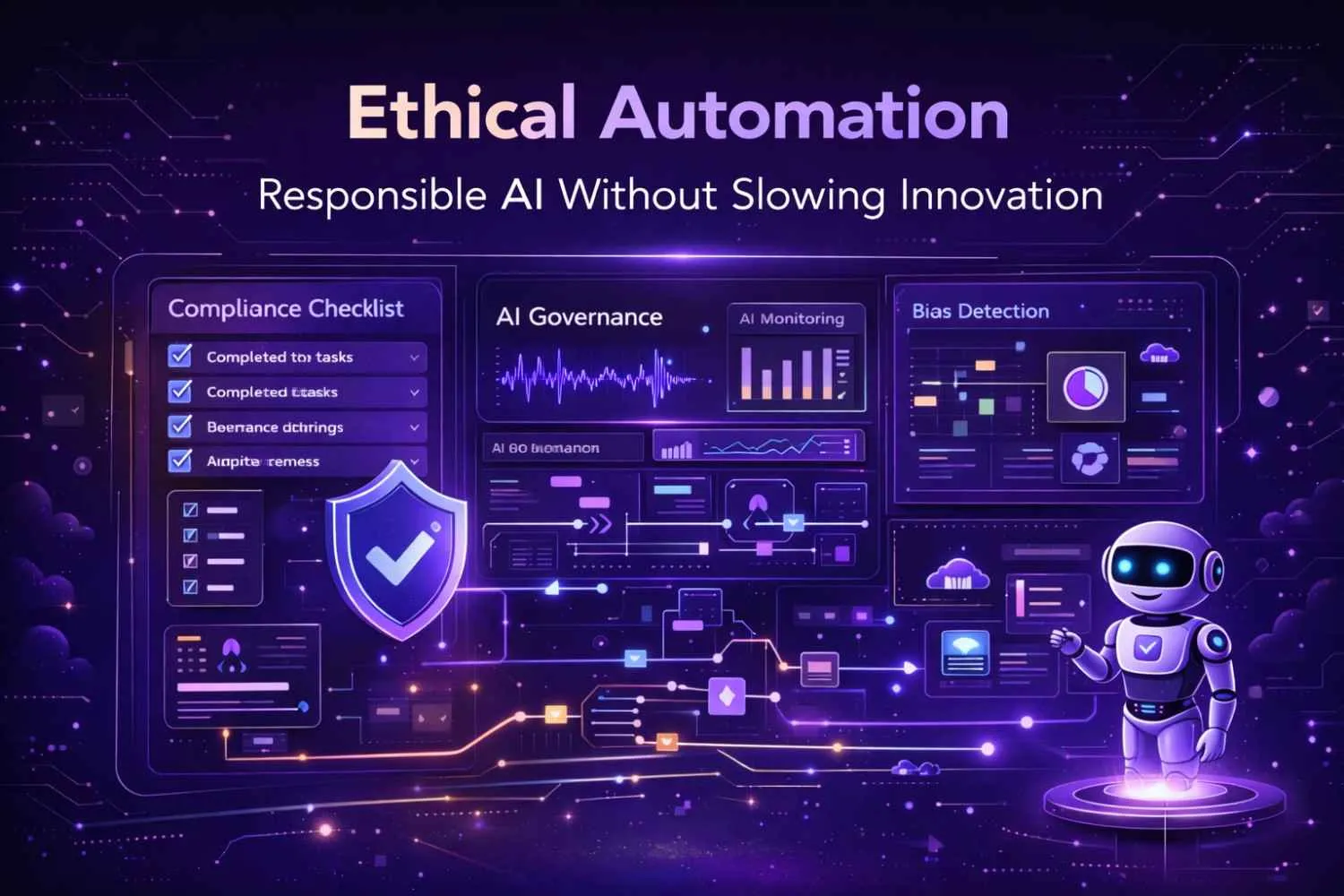
It’s 2026, and we all know that automation is the turning point that has been witnessing a massive growth globally. With all the emerging AI tools and free agents to explore, automation has already been an integral part of many firms and businesses worldwide. From automating workflows to analyzing massive datasets, automation has endless possibilities that are all being implemented for various use cases.
Now that automation has become integral to almost all firms, the real question is how businesses can innovate and scale without compromising ethics, safety, and transparency. This question arises because automation has no restrictions or limits and can be customized or built to perform any tasks a user insists on. This is where ethical automation enters the conversation.
Ethical automation implies designing and building AI systems that are fair, transparent, accountable, and align with human values while boosting innovation and growth. Global frameworks released by OECD and UNESCO explain that AI systems must value human rights, privacy, and democratic policies while being beneficial and helpful to the community.
So today, this blog is brought to you to help understand why ethical automation is necessary for modern businesses, the principles to follow, and the AI governance frameworks that companies use. So without any delay, let’s get started!
Why Ethical Automation Matters for Modern Businesses
Modern businesses rely on automated systems and AI tools to perform multiple tasks and reduce manual efforts. So systems are built according to their needs and requirements. But if an automation system is poorly designed, it can result in multiple risks, including safety issues, privacy concerns, and a lack of accountability.
A recent article, “The growing importance of ethical frameworks in responsible artificial intelligence development,” from Hack Diversity, shows that organizations are adapting to responsible AI frameworks and tools to reduce risks such as algorithmic bias, data misuse, and unintended harm. The following are some of the key reasons for ethical automation gaining much importance:
Global growth in AI adaptation
Increasing regulatory scrutiny for responsible AI deployment
Rising customer trust expectations
Long-term sustainability of AI systems
Core Principles of Ethical Automation
Responsible automation is built on multiple foundational principles and layers that are recognised by Global AI governance frameworks. The core principles include:
Fairness and bias mitigation
Transparency and explainability
Accountability and oversight
Privacy and data protection
Safety and security
When these principles are followed, the system tends to deliver responsible and valuable insights, boosting growth and innovation.
AI Governance Frameworks Companies Are Using
Organizations adapt to predefined and structured AI governance frameworks, which define the policies, processes, and monitoring systems to ensure responsible use of technologies. Common components of the AI governance frameworks include:
Risk assessment protocols: Evaluating potential risks before deploying the AI systems.
Model monitoring systems: Continuously monitor models to detect errors and anomalies.
Ethical review boards: Creating interdisciplinary committees containing technologists, legal experts, and ethicists to review the systems.
Documentation and transparency reports: Publishing transparency reports that describe how their systems work and how risks are mitigated.
Also Read: Sarvam AI and the Rise of India’s Sovereign AI Stack: What It Means for Startups and Enterprises
The Future of Ethical Automation
With the boom of AI and automation, ethical automation becomes a foundational requirement for all businesses in the future. The future of ethical automation includes responsible AI systems, including:
- AI governance platforms to monitor automated systems
- Regulatory frameworks for risk-prone AI applications
- Improved transparency requirements
- AI audits, similar to financial audit processes
It is an inevitable fact that AI and automation shape the future of businesses, but only when accompanied by responsibility. Ethical automation ensures that AI systems and frameworks remain fair, transparent, and accountable while boosting innovation and scaling success.
To put it simply, you need to be aware of the automation systems that are built for your business. Reach out to verified, valid platforms such as BeGig Studio to build personalised, ethical automation systems that last longer without any anomalies. Book a call with us today and let us make your next big automation dream come true!
Frequently Asked Questions (FAQ’s):
1. What is ethical automation?
Ethical automation means designing and developing AI automated systems that follow responsible AI principles such as accountability, fairness, transparency, and safety.
2. What is an AI governance framework?
An AI governance framework is the set of policies to ensure that technologies are used ethically and responsibly.
3. Does ethical automation slow innovation?
Ethical automation does not slow innovation; it ensures long-term scalability.
4. Where can I get an ethical automation system for automating my business processes?
Valid and verified platforms such as BeGig Studio are well-suited for building automation systems that follow ethical policies.
5. What are the four pillars of ethical AI?
Transparency, Fairness, Privacy & Security, and Accountability are the four pillars of ethical AI.
Never miss a story
Stay updated about BeGig news as it happens